After Daqadus, the Holy Family fled to Samannud which was once an important city in pharaonic and Ptolemaic times. It is said that the Holy Family stayed here between 14 to 17 days as they were warmly welcomed by the local population. We need to go through a narrow street to reach the famous Church of St. Apa Nub; a twelve year old 3rd century martyr. The church treasures his relics which are preserved in a tube and covered with spices and perfumes, following the way Jesus’ body was wrapped with spices: “And when the Sabbath was past, Mary Magdalene, and Mary the mother of James, and Salome, bought sweet spices, that they might come and anoint him.” [Mark 16:1]. The tube containing the relics is wrapped into a scarlet colored piece of cloth with the saint’s picture on it and is kept in a shrine. Occasionally priests remove the tube from the shrine in order to give the pilgrims blessings from it.
In the church’s courtyard we find a well that was blessed by Jesus, which is now covered to protect it from dirt and pollution. Water is pumped up via a purification installation and is given to people to drink. We see in the church’s courtyard a large granite bowl in which the Holy Virgin baked her bread, which is also covered for protection, and filled with water so that people can touch it as a blessing.

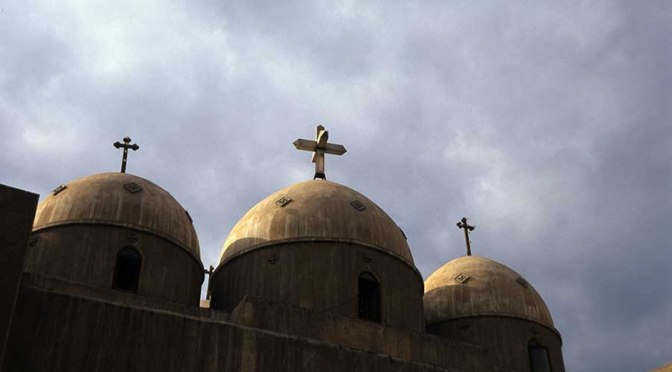
Photo: Norbert Schiller, church of Samannud.

Photo: Norbert Schiller, pilgrims touch the water inside a large granite bowl that the Virgin Mary is said to have baked bread in. The bowl sits in the church courtyard at Samannud and pilgrims come to this site to get blessings from a number of objects, including the bowl.

Photo: Paul Perry, the water of the well blessed by the Holy Family. Water is pumped out via a purification installation and is given to people to drink and to be blessed.

Photo: Paul Perry, the well of the Church of the Holy Virgin and St. Apa Nub which was blessed by the Holy Family during their stay of 14 to 17 days in the town of Samannud. The well is covered to protect it from dirt and pollution.

Photo: Paul Perry, intricate woodwork on the iconostasis and the royal door leading to the sanctuary of the Church of the Holy Virgin and St. Apa Nub at Samannud.

Photo: Paul Perry, beautiful paintings on the iconostasis of the Church of the Holy Virgin and St. Apa Nub at Samannud. We can see the big cross, the icons of the Last Supper, and the icons of the four Evangelists on it.

Photo: Paul Perry, a priest opening the place where the relics of St. Apa Nub are preserved at the Church of the Holy Virgin and St. Apa Nub at Samannud.
![Photo: Paul Perry, a priest carrying the relics of St. Apa Nub at the Church of the Holy Virgin and St. Apa Nub at Samannud. Observe the man who is kissing the relics of the saint so that he can receive his blessings. This is a familiar sight in the Coptic Orthodox Church, following the faith of the woman who had an issue of blood in the Bible who believed in the heavenly power in a mere touch of Jesus’ garment and “said within herself, If I May but touch his garment, I shall be whole” [Matthew 9:20-21].](https://i0.wp.com/holyfamilyegypt.com/wp-content/uploads/2017/04/dscn0925.jpg?w=154&h=115&ssl=1 "a priest carrying the relics")
Photo: Paul Perry, a priest carrying the relics of St. Apa Nub at the Church of the Holy Virgin and St. Apa Nub at Samannud. Observe the man who is kissing the relics of the saint so that he can receive his blessings. This is a familiar sight in the Coptic Orthodox Church, following the faith of the woman who had an issue of blood in the Bible who believed in the heavenly power in a mere touch of Jesus’ garment and “said within herself, If I May but touch his garment, I shall be whole” [Matthew 9:20-21].

Photo: Paul Perry, a narrow street in front of the church of the Holy Virgin and St. Apa Nub at Samannud.

Photo: Paul Perry, the entrance of the Church of the Holy Virgin and St. Apa Nub at Samannud.
 Holy Family in Egypt